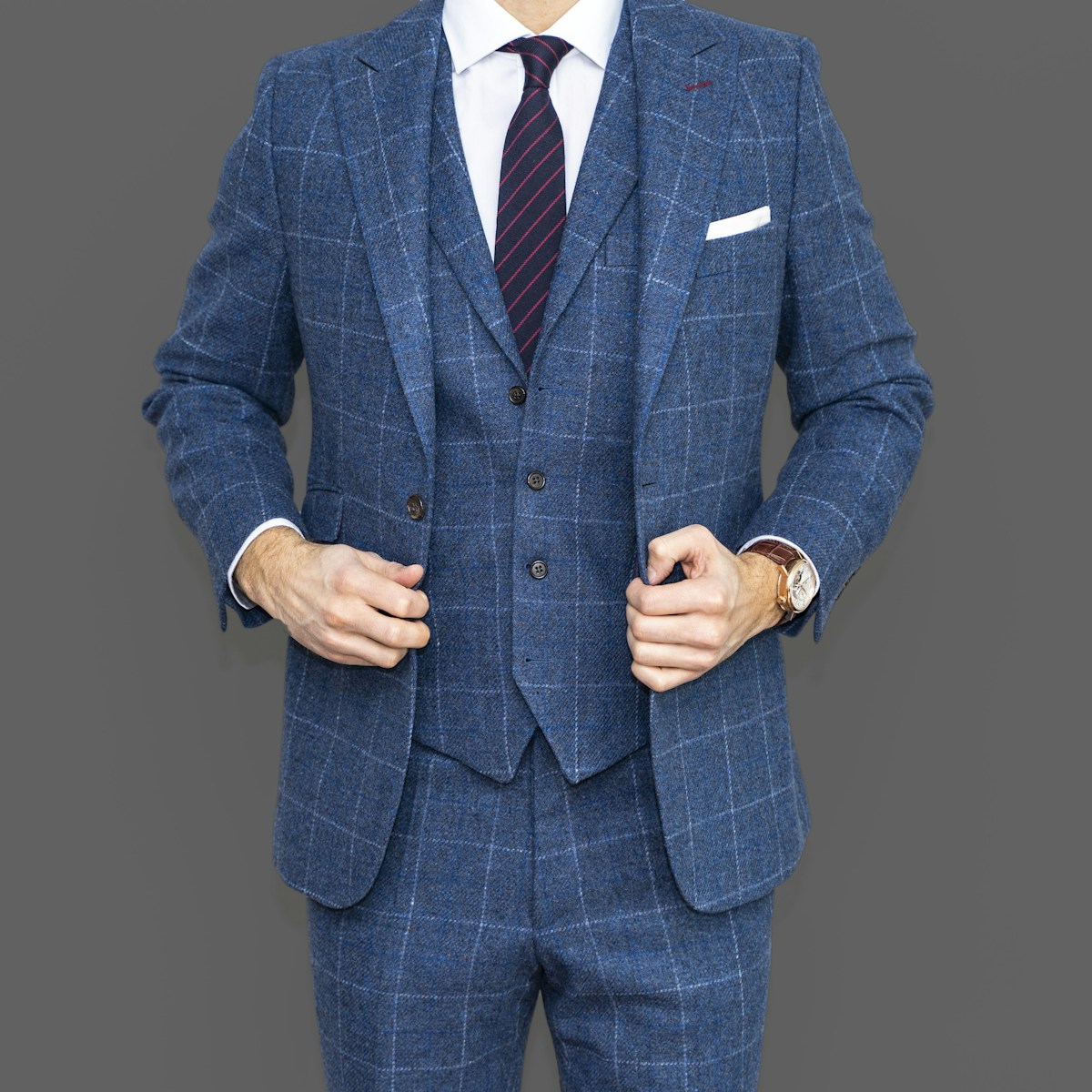
In the classical English tailoring tradition perfected along Mayfair's Savile Row during the nineteenth century, the gentleman's suit jacket was conceived primarily as armor. Its objective was structural correction: heavy horsehair chest canvasing, thick wadded shoulder roping, and rigid buckram interlinings were engineered to construct an idealized masculine silhouette—straightening the stooped shoulder, broadening the chest, and disguising the natural contours of the wearer's anatomy[1].
When Vincenzo Attolini and Domenico Caraceni began stripping this architectural armor away in Naples during the early 1930s, the traditional sartorial establishment viewed the move with deep suspicion. To remove the lining and the canvas seemed, at first glance, like an act of corner-cutting. In reality, it was the exact opposite: it removed the tailor's ability to hide sloppy craftsmanship beneath a smooth silk curtain.
The Mechanics of Naked Seams
In a conventional fully lined jacket, the cutter can afford internal seam allowances that are uneven, raw, or reinforced with synthetic fusible tape. The lining acts as a decorative facade. In a truly unlined (sfoderata) or quarter-lined garment, however, every internal stitch is visible. Every seam must be painstakingly French-bound with fine silk or bias-cut cotton, and every pocket bag must be hand-anchored directly to the outer cloth.
"The deconstructed coat is a confession. It exposes the precision of the iron, the tension of the thread, and the exactitude of the cutter's chalk." — Vincenzo Attolini, Notes on Neapolitan Patternmaking (1935)
Furthermore, without horsehair canvas to hold the chest in a pre-shaped parabolic curve, the garment depends entirely on the natural drape of high-twist worsted yarns—such as fresco or high-twist tropical wools[2]. The jacket no longer stands independently on a chair; it collapses into soft folds, regaining its structure only when warmed and animated by the living body of its owner.
Sprezzatura and the Posture of Ease
This mechanical shift profoundly alters human posture. Rigid tailoring enforces a stiff, militaristic stance. The unlined Neapolitan jacket—with its gathered shirt-sleeve shoulder (spalla camicia) and boat-shaped chest pocket (taschino a barchetta)—allows the arms full articulated rotation. It accommodates the gesture of pouring wine, leaning over a desk, or reaching for a book without the entire front of the jacket buckling.
Here lies the moral dimension of the garment. To dress with elegance without appearing to have labored over one's appearance is what Castiglione famously codified as sprezzatura[3]. The unlined jacket does not announce itself with aggressive shoulder padding or sharp angles. It settles onto the shoulders like a cardigan, signaling quiet mastery, self-possession, and ease in one's own skin.
Sources & Further Reading
- Attolini, Vincenzo (1935). The Soft Neapolitan Cut and the Abolition of the English Canvas. Sartoria Napoletana Historical Archive, Naples. [Primary Archive]
- British Textile Guild (2022). Thermal Comfort and Air Permeability of High-Twist Fresco Weaves. Journal of Material Dress, 44(2), 112–129. [Peer-Reviewed Study]
- Castiglione, Baldassare (1528). Il Cortegiano (The Book of the Courtier). Venice: Aldine Press. [Classical Primary Text]